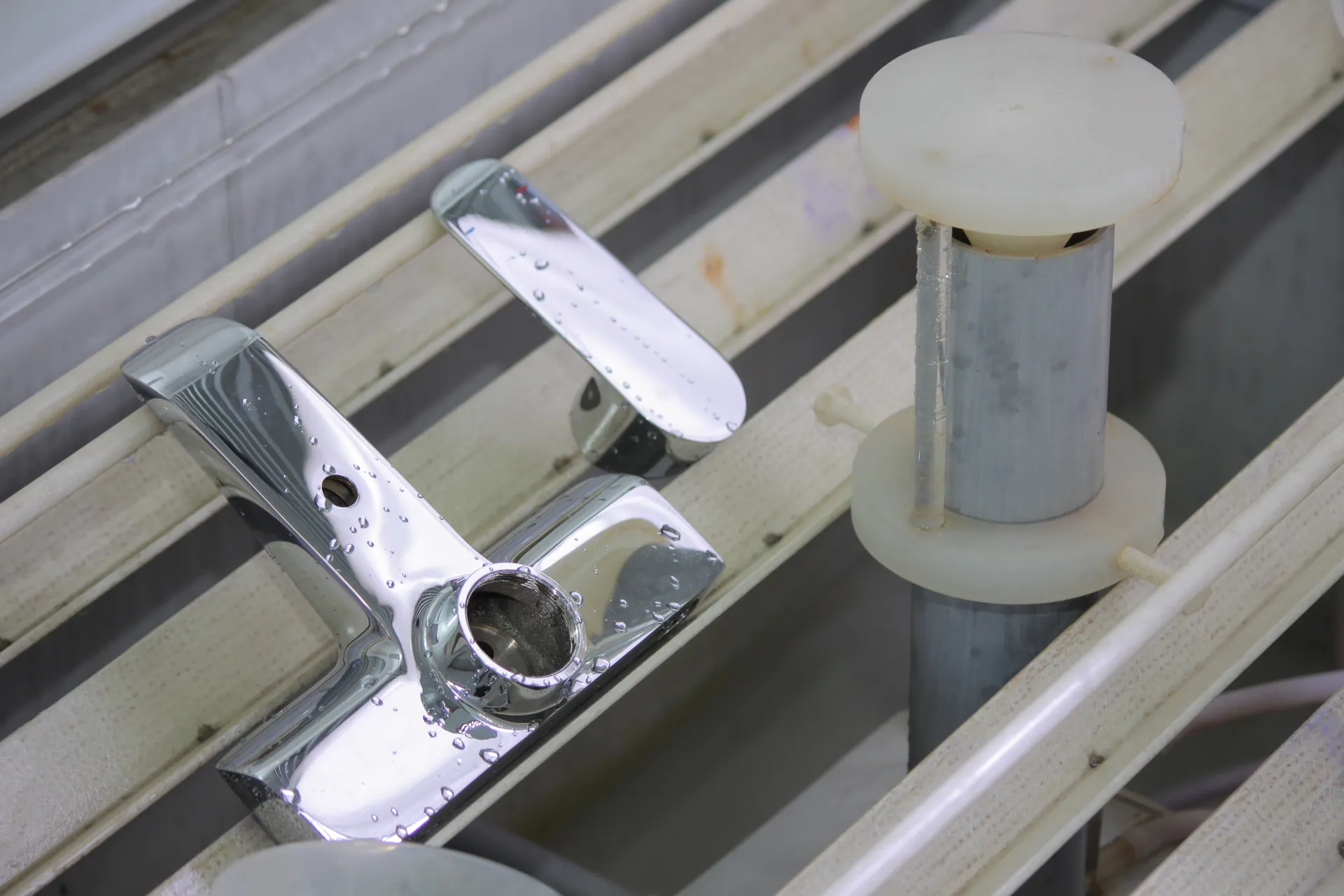
Electroplated sanitary fittings operate in humid, aggressive environments where chemical exposure is common. To guarantee that a chrome faucet retains its high-gloss finish without blistering, peeling, or corroding, manufacturers utilize simulated environmental acceleration testing.
Copper-Accelerated Acetic Acid Salt Spray (CASS) testing is one of the most rigorous and reliable accelerated corrosion tests in the world. Originally developed to evaluate the durability of decorative nickel-chrome coatings, it has become the standard quality-control metric for international luxury sanitary fittings.
2. CASS vs Standard Salt Spray (NSS)
Standard Neutral Salt Spray (NSS) testing utilizes a simple 5% sodium chloride solution at 35°C. While effective for simple rust evaluation on steel, NSS takes hundreds of hours to reveal coating failures on multi-layer copper-nickel-chrome electroplated brass.
The CASS test accelerates this process by a factor of 8 to 10. By introducing copper ions and lowering the pH to make the solution acidic, CASS testing replicates years of atmospheric exposure and household chemical cleaner degradation in a matter of 24 to 48 hours.
3. Chemical Mechanism of Acceleration
The CASS test solution is formulated by dissolving 5 parts of sodium chloride into 95 parts of distilled water, then adding copper chloride dihydrate (CuCl₂·2H₂O) at a concentration of 0.26 g/L. Crucially, the solution is acidified with glacial acetic acid to lower the pH to a range of 3.1 to 3.3.
The chamber operates at an elevated temperature of 49°C. The combination of high temperature, low pH, and copper ions creates a highly corrosive environment. The copper ions act as a powerful catalyst, accelerating galvanic corrosion at any microscopic pinholes or crack boundaries in the chromium layer.
4. Evaluating Defect Patterns and Ratings
Following CASS exposure—typically specified at 16, 24, or 48 hours depending on product requirements—parts are carefully cleaned and evaluated. Inspectors check for surface defects such as copper corrosion bleed, nickel blistering, chrome peeling, or deep pitting.
Products are rated on a standard scale from 0 to 10 based on ISO 10289, representing the percentage of surface area affected by corrosion. A premium sanitary fitting must typically score a Rating 9 or 10 to pass international specifications.
5. Global OEM Standards and Compliance
Major European and American sanitary brands enforce strict CASS requirements. For instance, ASME A112.18.1/CSA B125.1 in North America and EN 248 in Europe define the testing protocols that sanitary components must satisfy.
Our in-house CASS chamber allows us to perform regular batch testing and continuous process auditing. This capability ensures our electroplating formulations remain robust and stable, helping partners pass third-party certification testing.
Whether you are exploring plating services, faucet OEM/ODM manufacturing, mold development, or quality documentation support, our team is ready to discuss your project.